
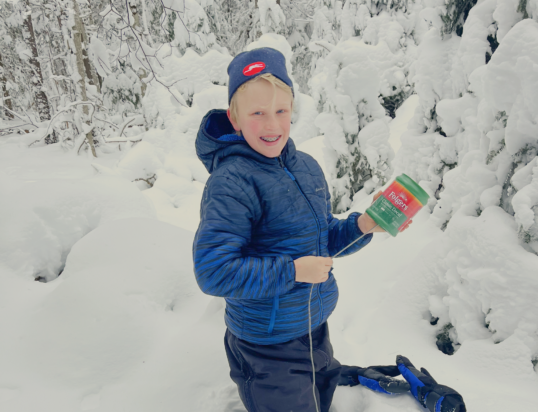
Patience has never been my strong suit. I like productivity and fast results. But winter—and my ten-year-old grandson—had a different lesson in mind for me.
While at our cabin in northern Wisconsin, Mason snowshoed off into the woods alone. He returned minutes later, eyes wide. “I heard a moose!”
We’d talked before about how, several years ago, a neighbor saw a moose in the area. Sightings were rare—but not impossible.
“It would be incredible to see a moose," I said. "Let’s make a moose call and go back out there.”
I’d seen directions on YouTube. Within minutes, I’d unlaced a shoestring from an old pair of shoes, cut a small hole in the lid of a one-pound Folgers coffee can, threaded the lace through, and knotted the end.
“Short call sounds like a female moose; a longer one sounds like a bull,” I said, wetting the string and demonstrating. “Lead the way, Mason.”
As we snowshoed, I chatted about the time I’d stepped out of my tent on Isle Royale—the national park where scientists study the predator-prey relationship between wolves and moose. I was brushing my teeth when I looked up and saw a bull moose only yards away.
“Good thing it wasn’t fall, when they go into rut,” I told Mason, “or I might’ve been in trouble.” As it was, the moose simply turned and disappeared into the brush.
“So it’s winter,” Mason said thoughtfully, “which isn’t that much later than fall, really.” Then, teasing, he added, “If one comes charging, I just have to be faster than you, right Grammy?”
I laughed to hear the old family joke we often told while hiking in bear territory.
We were nearly out of the trees when, on the opposite shore of the swamp, I caught a blur of movement.
“Mason!” I pointed—but the brown shape was already gone. “It looked more the size of a deer,” I said, although every fiber of my being wanted it to be a moose.
“What do moose tracks look like?” he asked.
“Like deer tracks,” I said, “only much bigger.”
We spotted deer beds in the snow and many hoofed tracks—some surprisingly large.
“Grammy, you know how deer rub trees so the bark falls off?” Mason pointed to an area high on a trunk. “Do moose do that, too?”
“I think so.”
“Look at this.”
The sheared bark could have been caused by a pileated woodpecker, but it could also have been moose rub marks.
Imagining the possibility that a moose really might be living near our cabin gave me a shiver—the good kind.
“Let’s try our call,” I said.
The string was still wet. I gave what I hoped was an impressive imitation of a female moose. Mason and I looked and listened intently.
The sound echoed through the trees and carried into the swamp. The chickadees stopped calling as if they, too, wanted to listen. We heard a creaking noise, and Mason's eyes widened.
"That's two trees rubbing together in the wind," I whispered.
He nodded.
"I'll try the bull call."
The rasp of the wet string sounded authentic, and I held my breath.
The odds of a moose calling back—or stepping into view—were minuscule.
But there was a chance, right?
We heard a crow and a distant dog, but no answering bellow. Still, Mason kept scanning the woods—hopeful, alert, ready.
He wasn’t disappointed. He didn’t rush me or ask if we were done. He simply stood there, listening, as if the woods might speak if given enough time. Watching him, I realized how rarely I allow myself that kind of patience—waiting without guarantees.
In the new year, I want to be more like Mason—eyes open, senses patiently tuned, willing to believe that something remarkable might be out there.
Because sometimes maybe is all we need.
7 Replies to “Calling for a Moose”
Nice!!!
Thanks for reading, Gayle. If our next adventure happens to be in moose territory, I’ll bring my moose call so we can try our luck. 🙂
Beautifully written-amazing sentiment.
Thanks, Heidi. We may invite you along next time. 🙂
Love this. Such a great adventure and making memories!
Thanks for reading and commenting, Beth. I know you’re having great adventures and making memories with your grandchildren too.
looks like your grandkids love nature as much as you do….wonderful